Within the intensely competitive arena of contemporary serious sliding, victory is far more than purely a function of raw horsepower or behind-the-wheel bravado. Rather, it is now a complex discipline which necessitates a scrupulous blend of picking a proven vehicle platform, equipping it with the highest-quality performance hardware, and, most essentially, comprehending its live behavior on the circuit through sophisticated suspension tuning applications. This exhaustive guide functions as your master plan from the initial idea of a drift build through to the final engineering-refined adjustments that turn a powerful car into a repeatable winner. We will examine in detail the art and science of vehicle alignment optimization, showing how a modern drift tuning app like a dedicated telemetry system eliminates assumptions and provides unmatched clarity into your car's real-world behavior.
The foundation of any great drift car is, without question, the platform itself. Several vehicles have earned renowned standing within the international oversteer scene due to their built-in balance, durable construction, and the enormous availability of specialist components available. Picking the correct car is the primary and most crucial selection a enthusiast will make. For instance, the the E36 generation BMW is widely regarded as perhaps the the best overall drift platforms of all time. Its almost ideal balanced front-to-rear weight, combined with a rear-wheel-drive setup and extremely reliable inline-six motors, creates a platform that is both accessible for beginners and highly effective in the possession of a expert competitor. The successor of this lineage, the E46 model BMW, refines these qualities with a even more sophisticated frame, increased track for greater high-speed stability, and yet more turning capability as standard from the OEM. A distinct powerful option in the pro arena is the C6 generation Corvette.
This muscle-derived track weapon introduces a unique combination of advantages to the sideways world, such as a low-mass aluminium structure, a rear-mounted transaxle that helps create an ideal balance, and the colossal torque of a large-displacement LS-series V8 engine. This blend makes it an absolute force on track, capable of starting and maintaining long angles with apparently minimal deployment of throttle. For drivers seeking remarkable performance per dollar, the Nissan Z33 rises above as a excellent example. It is delivered from the factory with a rigid body structure, a competent OEM limited-slip differential, and the responsive V6 powerplant that delivers ample power and torque for practicing and advancing in the sport. Its follow-up, the 370Z model, brings additional refinements in body strength, handling precision, and overall powerplant performance, establishing its position as a favorite selection among professional pilots. Other historic vehicles that deserve attention include the agile rotary-powered Mazda FC, the ever-present Nissan S13 240SX, the American SN95 generation Mustang, the modern BMW E90, and the small yet unbelievably engaging and instructive Mazda Miata. All of these cars offers a unique array of traits, difficulties, and potentials, but they all share the basic elements necessary to serve as a capable drift car.
However, picking the correct chassis is merely the beginning. To release the complete performance of any of these vehicles, substantial upgrades to the steering system and suspension systems are absolutely mandatory. This is where the realm of precision tuning components comes into critical view. The single most impactful modification for a serious drift machine is the fitting of a high-performance drift angle kit. These advanced assemblies, for example those developed by performance brands like SLR, are designed to dramatically enhance the car's possible steering angle. A factory street car is severely restricted in how far its tires can pivot, a safety compromise for on-road operation. In drifting, however, aggressive countersteering is constantly required to control and sustain a slide. An modification kit replaces the OEM steering knuckles, linkages, and sometimes control arms with parts that permit the wheels to achieve angles over 70 or even 80 °, compared to a average stock angle of around 40 to 50 degrees.
This immensely greater capability provides the driver with exponentially more authority during a drift, allowing it to be far more straightforward to start a oversteer moment, sustain it through a long corner, and change seamlessly from one side to the other. The improvement in handling is nothing short of transformative. Combined with a correctly specified angle kit is the every bit as essential upgrade to the vehicle's suspension. Generic or including high-end sport coilovers are simply not intended for the particular and extreme demands of competitive oversteer. A drift-spec system of suspension units is paramount. These specific dampers have unique piston tuning and spring strength that are tuned for the violent weight transfer that is typical of aggressive driving. When a pilot starts a angle, the vehicle's inertia is thrown violently to the outer of the corner. Optimal competition coilovers control this movement in a consistent manner, permitting the vehicle to stabilize quickly and offering the pilot accurate feel through the wheel and cockpit. They additionally provide exact setting of ground clearance, rebound and compression firmness, and corner weighting, which are all fundamental aspects of fine-tuning the chassis's behavior to a given track or competition technique. In combination, a high-quality drift angle kit and a correctly chosen set of competition coilovers constitute the core hardware foundation upon which all subsequent tuning is built.
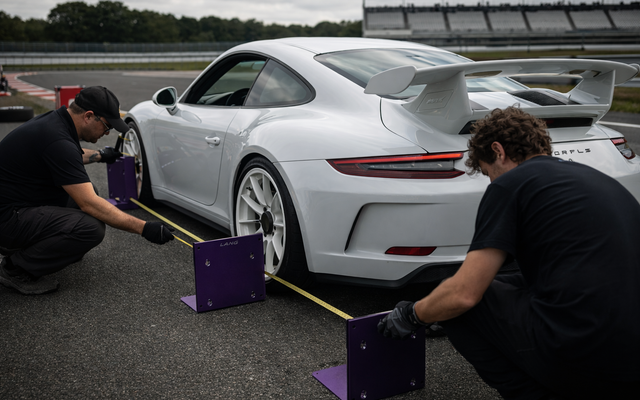
Once the core hardware is installed, the subsequent vital phase in the build is the precise setting of the chassis's alignment. This is the domain of chassis dynamics adjustment, a process that can feel overwhelmingly complex to the beginner but is, in reality, the defining factor to converting a assembly of capable parts into a harmonious and predictable vehicle. The most debated element of alignment for oversteer is definitely negative camber. Wheel camber is the tilt of the tire in relation to the upright plane when observed from the front of the vehicle. If the top of the tire is tilted towards the chassis, this is referred to as negative camber. For oversteer driving, negative camber on the front wheels is universally employed and is seen as essential. The logic is fundamentally linked to tire contact.
When a vehicle is going around a bend at extreme sideways angles, the chassis rolls to the outer of the bend. This body roll forces the outer front wheel to lose its ideal grip area with the tarmac. By applying inward lean, the tire is pre-tilted to counteract this lean. As the car rolls into the corner, the outside front tire flattens out with the road surface, increasing its bite at the precise moment when it is absolutely essential for steering authority. Typically, front axle camber settings for a competition sliding vehicle fall between approximately -3 degrees to as high as -5 degrees or even greater, depending on the parameters of the chassis configuration, rubber selection, and pilot preference. The back tires also utilize inward lean, but the values are usually more conservative and less aggressive than the front. Overly aggressive inward lean at the rear can cause the vehicle to overly prone to oversteer and hard to predict on power use, as it reduces the effective contact patch of the driving wheels during straight-line power delivery. Therefore, rear axle adjustments are often in the vicinity of -1 degree to -3 degrees, finding a delicate compromise between giving adequate side bite to assist in initiating and sustaining the angle while still preserving usable hook-up for acceleration the turn. alignment is merely one component of the broader alignment picture, which additionally involves toe setting, self-centering steering, and bump steer adjustment.
Toe angle describes the angle of the tires when looked at from above. Inward toe means the leading edges of the tires are closer together than the rear edges, while negative toe means the opposite. For sliding, a slight amount of front axle negative toe is often employed to sharpen the initial steering reaction, making the vehicle feel more responsive and willing to begin a oversteer moment. Rear axle toe is generally set to neutral or a incredibly minute amount of toe-in to foster straight-line stability under throttle. caster angle is the frontwards or backwards angle of the kingpin axis when looked at from the lateral of the chassis. Increased caster angle enhances steering feel and high-speed solidity, and it furthermore boosts negative camber gain during steering, which is extremely advantageous. Adjusting these parameters is a detailed interaction where a change to a single parameter can and will influence the remaining parameters. The old-school approach for dialing in a chassis's alignment for drifting has long been a time-consuming endeavor of trial and error. A driver or crew would apply a adjustment based on a hunch, run the chassis on track, use the operator's individual feel and comments, and then apply a further tweak. This process would iterate time after time until the car felt "right" or the allotted testing time was exhausted. This system is not just exceptionally inefficient in terms of hours and costs, but it is furthermore fundamentally imprecise.
Human perception is a famously subjective data source, influenced by countless elements such as exhaustion, varying track conditions, weather, and just the mood of the operator on that given day. What feels "loose" on one lap might feel "tight" on the following lap, leading to contradictory information and counterproductive changes. This age-old problem in vehicle dynamics optimization is precisely where state-of-the-art technology has made its mark to completely change the landscape.
The rise and application of advanced drift telemetry software has brought about a new age for tuning and refining high-performance sliding vehicles. This new generation of tools, exemplified by innovative products like modern telemetry hardware, work by directly measuring the real-time mechanical movement of the chassis as it is being driven on the circuit. As opposed to using driver feel, these devices gather quantifiable metrics on essential factors such as damper compression and extension, individual tire rotation, acceleration forces, wheel angle, and accelerator and brake pedal application. This collected telemetry is then processed by advanced software that can visualize and interpret the data in a clear manner. For the first time ever, engineers and teams can observe precisely what the chassis is doing at every millisecond of a drift. This ability revolutionizes the complete suspension tuning process. Imagine the specific task of setting the front camber for a particular car. As an alternative to applying a adjustment from -3 degrees to -3.5 degrees and then running several laps to try and "feel" a difference, a vehicle dynamics tool can give real-time and definitive data. The application can display graphically how the wheel's contact patch is performing during the key phases of a angle: turn-in, sustain, and switch. It can show if the present camber setting is allowing the outside front tire to maintain ideal grip or if the tire is overloaded on its outer shoulder.
The tool can subsequently make data-driven advice for adjustment. Perhaps the telemetry reveals that the outside front tire is even overworking its outer shoulder at -3.5 degrees of camber, suggesting that an increase to angle, say -4 degrees, might be beneficial. On the other hand, the information might indicate that the tread is failing to coming up to temperature or that the inner shoulder is degrading unevenly, which could indicate that there is overly aggressive negative camber and a small reduction back to -3.2 degrees would be more efficient. This standard of granularity and useful intelligence was simply unattainable in the days of pure mechanical setup.
The impact of employing a dedicated vehicle dynamics tool extends much further than only setting camber. It becomes an invaluable coilover setup tips that is specific to your specific vehicle. When setting the shock absorber settings on your suspension, instead of depending on general advice or replicating another car's setup, you can employ the telemetry to observe how the car is reacting in reaction to your changes. The application can show the wheel movement data over a lap, revealing if the dampers are managing the body movement properly or if they are allowing vehicle dynamics tool the vehicle to bounce too much after a flick. It can help in pinpointing problems like bottoming out or excessive extension, allowing you to introduce educated decisions to helper springs, damping values, or ride height. This process applies equally to the intricate process of car alignment tuning. In addition to camber angle, the system can give analysis into how modifications to toe and caster are impacting the chassis's stability during various phases of a slide. For example, it can assist you to ascertain the ideal amount of front axle negative toe for your specific steering setup and piloting technique by analyzing the quickness of initial response and the consistency of the car at lock countersteer. This transforms the tool an extremely effective performance optimization handbook that is dynamically updated by the actual performance of your own car on the track. It moves the complete endeavor from a mysterious craft into a methodical engineering procedure.
Furthermore, the utility of a system like GripDial is in no way restricted to expert tuners with vast budgets. For the grassroots competitor, it serves as an amazing force multiplier. It practically gives the tuner with the analysis of a expert dynamics engineer without requiring the typical expense. It accelerates the development time by delivering unambiguous solutions to challenges that would otherwise take seasons of trial and error to understand. A builder can understand how their specific chassis reacts to different inputs, developing a more profound knowledge of car control in the journey. It also opens up high-level performance tuning concepts, enabling all drivers with the drive to optimize their machine to do so in a systematic and successful manner. This is especially significant in a sport like oversteer competition, where setup know-how has in the past been a closely guarded commodity among elite drivers. Today, that power can be in the hands of any motivated enthusiast.
In conclusion, the process to building and dialing in the perfect championship-contending sliding vehicle is a multi-stage mission that smoothly combines classic suspension tuning tool mechanical wisdom with revolutionary data tools. It commences with the informed pick of a legendary chassis, followed by the installation of critical performance components like maximum-angle steering angle kits and properly valved drift-spec coilovers. The process then advances into the detailed realm of alignment optimization, where settings like camber angle, toe, and caster are meticulously configured to complement the car's modified geometry and the pilot's specific needs. The final step, and what really distinguishes the contemporary approach from the traditional methods, is the use of a advanced vehicle dynamics tool. This tool eliminates the approximation and waste of purely subjective adjustment by delivering objective, actual telemetry on how the chassis is truly performing. It functions as an unparalleled diagnostic aid, a actionable alignment optimization handbook, and a comprehensive vehicle dynamics tool. As a complete package, this integrated methodology guarantees that every component of the drift car—from the pick of the platform to the most minute adjustment on the suspension—is refined for ultimate success on the track. It signifies the full maturation of the art of sliding, connecting raw pilot talent with precise vehicle car alignment tuning setup to create the perfect effective cars attainable.